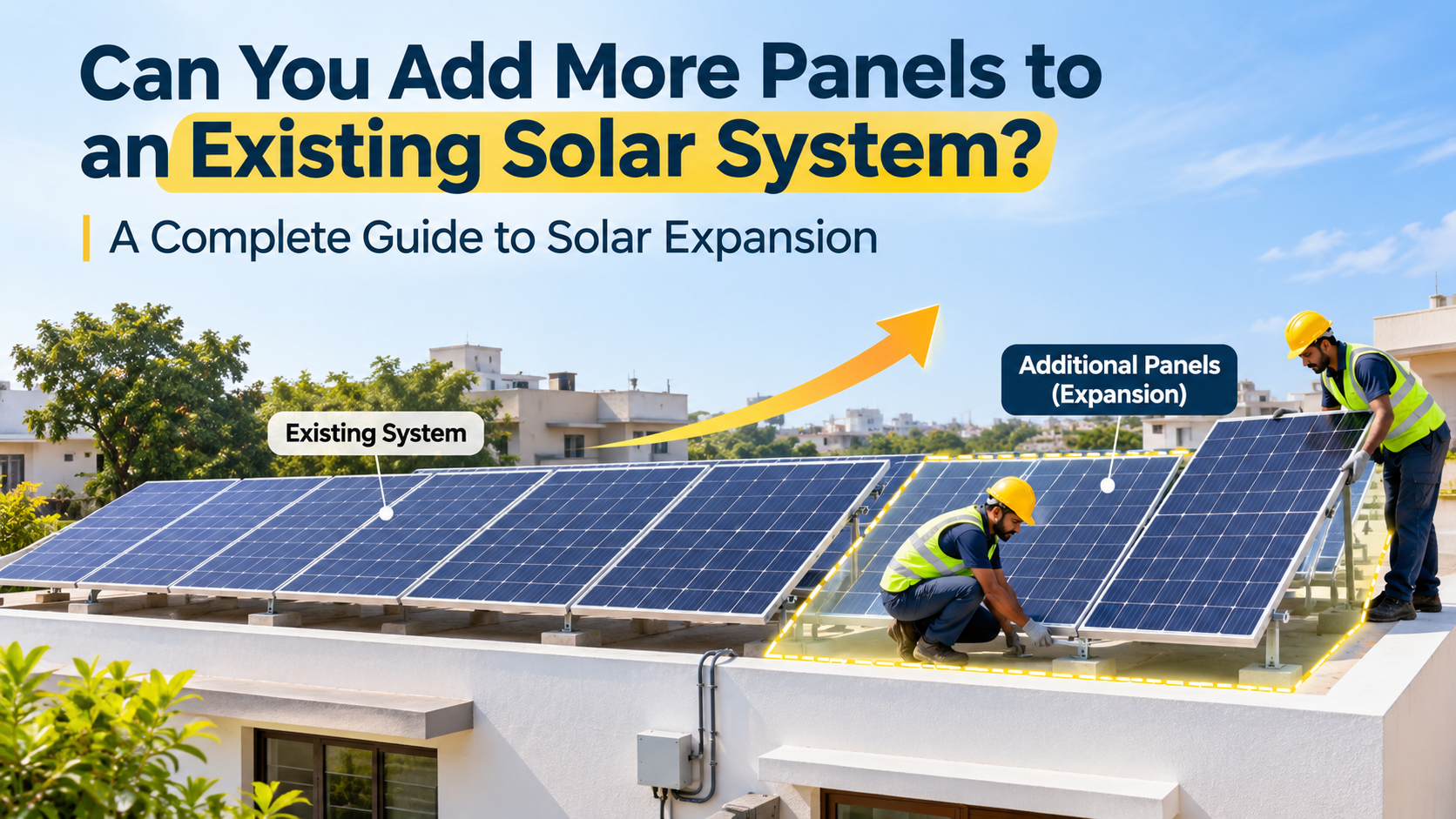
Your electricity needs can grow. Your solar system may be able to grow with them.
Installing rooftop solar is a long-term investment. But what happens when the solar system you installed a few years ago no longer meets your electricity requirements?
Perhaps you have installed additional air conditioners, purchased an electric vehicle, expanded your business, or simply started consuming more electricity than before.
The good news is that you can often add more solar panels to an existing solar system without replacing the entire installation.
However, solar expansion is not as simple as placing extra panels on the roof. Your existing inverter, electrical configuration, roof structure, and local electricity board regulations must all be considered.
According to Mercom India Research, India added 6.6 GW of rooftop solar capacity during the first half of 2026, representing 131% year-on-year growth. As rooftop adoption increases, understanding how existing systems can be expanded is becoming increasingly important.
In this guide, Daystar Solar explains when solar expansion makes sense, how it works, what it costs, and what homeowners and businesses in Chennai should know before upgrading.
1. Why Would You Need More Solar Panels?
A solar power system is generally designed around the electricity consumption and requirements of a property at the time of installation.
Over time, those requirements can change.
Increasing household electricity consumption
A home that initially required a 3 kW rooftop solar system might experience higher electricity demand after adding air conditioners, appliances, or additional occupants.
If grid electricity consumption remains high despite the existing solar installation, expanding the system may be worth considering.
Electric vehicle charging
Electric vehicles introduce a new electricity requirement. Homeowners planning to charge an EV regularly may benefit from increasing their daytime solar generation.
Commercial and industrial expansion
Schools, offices, factories, and commercial establishments may experience increasing electricity consumption as their operations expand.
For these properties, solar capacity enhancement can help offset additional electricity purchases.
Future energy requirements
Instead of installing an entirely new solar plant, some property owners may be able to expand their existing infrastructure. Whether this is financially worthwhile depends on the condition and compatibility of the original system.
Important: A higher electricity bill does not automatically mean you need more panels. Poor generation could also result from dust accumulation, shading, equipment faults, or maintenance issues. Existing system performance should be evaluated first.
2. Is It Technically Possible to Add More Panels to an Existing System?
Yes, but feasibility depends on several factors.
A. Existing inverter capacity
The inverter converts the direct current (DC) generated by solar panels into alternating current (AC) used by electrical appliances or supplied to the grid.
Every inverter has technical limits, including:
Maximum permissible solar PV input power
Maximum DC input voltage
Maximum input current
Maximum Power Point Tracking (MPPT) operating range
Number of available MPPT inputs
Rated AC output capacity
For example, a homeowner may have an existing 3 kW solar system and wish to increase it to 5 kW.
Before installing another 2 kW of solar panels, a solar engineer must determine whether the existing inverter supports the proposed total PV capacity and string arrangement.
Some inverters permit solar array capacity to exceed their rated AC output, within manufacturer-approved limits. This is known as DC oversizing.
However, exceeding the inverter's operating or safety limits is not acceptable. Furthermore, an oversized array can experience inverter clipping, where available solar generation exceeds what the inverter can convert at that moment.
If the existing inverter cannot safely support the additional panels, an inverter upgrade or a suitably designed second inverter may be required.
B. Solar panel compatibility
Technology has advanced considerably in recent years.
An older system may use 330 W, 400 W, or other panel ratings, while newer modules may offer substantially higher wattage.
But can different solar panels operate together?
Yes, provided they are electrically compatible and correctly configured.
Panel specifications such as operating voltage, operating current, open-circuit voltage, and short-circuit current must be considered.
Connecting panels with significantly different characteristics to the same string can create mismatch losses and reduce generation.
Where appropriate, engineers may use separate strings, independent MPPT inputs, or another compatible inverter configuration.
Using a newer panel model does not automatically mean every existing panel must be replaced.
C. Available rooftop space
Even when the inverter supports additional panels, the property must have suitable installation space.
A rooftop assessment should examine:
Shadow-free roof area
Orientation and tilt
Nearby buildings, water tanks, and trees
Mounting structure suitability
Roof condition and waterproofing
Structural load capacity
Safe access for cleaning and maintenance
For coastal areas such as Chennai, corrosion-resistant mounting components and appropriate electrical protection are also important considerations.
D. Electrical safety and supporting components
Adding panels can change the electrical requirements of an existing solar installation.
Depending on the proposed design, upgrades may be needed for DC cabling, connectors, DC distribution boxes, isolators, surge protection devices, protective earthing, and related equipment.
An expansion should be evaluated as an engineering modification rather than a simple panel addition.
3. Three Ways to Expand an Existing Solar System
Option 1: Add panels to the existing inverter
If the existing inverter has sufficient permissible PV input capacity and the proposed electrical configuration is compatible, additional panels may be integrated without replacing it.
This approach can reduce the need for new equipment.
It is most suitable when the inverter is in good working condition and supports the expansion.
Option 2: Upgrade the existing inverter
If the current inverter cannot support the proposed system capacity, replacing it with an appropriately rated inverter may be necessary.
This option is worth evaluating when the existing inverter is old, unreliable, or no longer suitable for future electricity requirements.
The replacement must be compatible with both existing and additional solar modules.
Option 3: Install an additional inverter or separate solar array
For larger systems or installations with multiple roof sections, a separate inverter may provide a practical solution.
This configuration can allow additional panels to operate without forcing electrically mismatched modules into the original strings.
The design must still comply with electrical protection, metering, grid connectivity, and utility requirements.
Which option is best?
There is no universal answer. The appropriate solution depends on your existing plant design, expected generation, expansion budget, and long-term requirements.
4. Example: Expanding a 3 kW Solar System to 5 kW
Consider a Chennai homeowner with an existing rooftop solar system.
Parameter | Capacity |
|---|---|
Existing solar system | 3 kWp |
Proposed additional capacity | 2 kWp |
Total proposed solar capacity | 5 kWp |
Example new panel rating | 500 W |
Number of additional panels | 4 |
The calculation is straightforward:
4 panels × 500 W = 2,000 W = 2 kWp
However, this calculation only establishes the additional rated panel capacity.
The installer must still confirm whether the four new panels can be connected in a technically suitable arrangement.
How much additional electricity could it generate?
Suppose the additional 2 kWp array achieves an average specific yield of 4 kWh per kWp per day.
Estimated additional generation:
2 × 4 = 8 kWh per day
Over 30 days:
8 × 30 = 240 kWh per month
This is an illustrative calculation, not a guaranteed output.
Actual generation depends on sunlight, shading, orientation, temperature, system losses, inverter limitations, and weather conditions.
Inverter clipping or electrical restrictions could also reduce the incremental generation.
The financial benefit depends on how much additional electricity is consumed directly and how exported energy is credited under the applicable billing arrangement.
5. Do You Need Electricity Board Approval to Add Solar Panels in Tamil Nadu?
For a grid-connected rooftop solar system, capacity enhancement should be reviewed with the relevant electricity distribution utility before modification.
In Tamil Nadu, the process is administered through TNPDCL and the applicable state regulatory framework.
The Tamil Nadu rooftop solar portal provides an online service titled Solar Additional Load.
Depending on the proposed expansion, additional requirements may include:
Capacity enhancement application
Review of sanctioned load or contracted demand
Updated solar system details
Grid connectivity and technical compliance verification
Revised metering or interconnection documentation
Inspection or other required approvals
The exact steps depend on the consumer category, original approval, system configuration, and current rules.
An existing net meter does not automatically authorize unlimited solar capacity expansion.
Before adding panels, confirm the required approval process with TNPDCL or a qualified solar installation provider.
Official portal: https://www.tnebltd.gov.in/usrp/
6. Can You Get a Government Subsidy When Expanding Solar Capacity?
This is an important consideration for residential solar owners.
Under the central PM Surya Ghar: Muft Bijli Yojana, the standard residential Central Financial Assistance structure provides support for eligible system capacity up to 3 kWp.
The central subsidy is capped at ₹78,000 for standard-category states under the published scheme structure.
But what if you already have solar?
MNRE's scheme guidelines contain provisions for certain previously subsidized residential installations that are expanded later.
For example, the guidelines illustrate a household that previously installed a 1 kW system under PM Surya Ghar and received ₹30,000.
If the household subsequently increases the total installed capacity to 4 kW, the guidelines illustrate potential additional central assistance of ₹48,000 for the eligible balance capacity up to 3 kW overall.
This does not mean every expanded system receives a fresh subsidy.
A homeowner whose existing installation already meets or exceeds 3 kWp generally cannot claim further standard central assistance merely by adding more panels beyond that capacity.
Subsidy eligibility also depends on applicable domestic-content requirements, vendor conditions, prior assistance, documentation, and scheme approvals.
Additional Tamil Nadu state assistance, where applicable, must be checked separately against the current state scheme's eligibility and disbursement conditions.
For the latest rules, refer to the PM Surya Ghar National Portal:
7. How Much Does It Cost to Add More Solar Panels?
The cost of solar expansion depends on more than the number of new modules.
Important cost factors include:
Solar panel technology: Module efficiency, specifications, manufacturer, and warranty influence the equipment cost.
Inverter compatibility: Retaining an existing inverter may be less expensive than upgrading or adding another inverter.
Mounting and structural work: New mounting structures, rooftop reinforcement, or additional access arrangements may increase costs.
Electrical modifications: Cabling, protections, isolation equipment, and distribution-box modifications may be necessary.
Installation and approvals: Labour, testing, inspection, documentation, and applicable utility charges can affect the final project cost.
Unlike a completely new installation, a small expansion may have a higher installation cost per watt because several fixed activities must still be carried out.
For this reason, an accurate quotation should be based on a site inspection and existing-system assessment.
8. Will Adding More Panels Automatically Reduce Your Electricity Bill?
Not always.
Adding more panels increases the potential solar energy available, but the financial result depends on electricity consumption patterns and the applicable tariff structure.
Consider two situations.
Situation A: Higher daytime electricity consumption
A business uses substantial electricity during working hours and has sufficient demand to consume additional solar generation directly.
Expanding solar capacity may reduce the electricity drawn from the grid.
Situation B: Limited daytime consumption
A home already exports substantial daytime solar energy but consumes most of its electricity at night.
Adding more panels may increase grid exports without producing an equivalent increase in bill savings.
In this situation, the homeowner should evaluate the economics of additional generation, load scheduling, and, where appropriate, battery storage.
Remember that adding panels alone does not provide backup power during grid outages. A conventional grid-tied inverter normally shuts down during a power cut for safety. Backup requires a compatible system designed for that purpose.
The goal is not simply to install more panels. It is to maximize useful generation and long-term financial returns.
9. How Daystar Solar Approaches Solar Capacity Expansion
At Daystar Solar, an effective solar system begins with understanding the property, its energy requirements, and its existing infrastructure.
For an expansion project, the evaluation process can include the following stages.
Step 1: Review existing electricity consumption
Assess recent electricity bills and identify whether energy demand has increased.
Step 2: Evaluate current solar generation
Review inverter monitoring data, performance trends, and any history of faults or underperformance.
Step 3: Inspect the existing equipment
Check panel condition, inverter specifications, mounting structures, wiring, and electrical protection systems.
Step 4: Assess rooftop feasibility
Identify suitable locations for additional panels while considering shading, structural condition, and maintenance access.
Step 5: Design the proposed expansion
Compare possible configurations and estimate incremental generation.
Step 6: Confirm statutory requirements
Review the applicable electricity board approval and metering requirements before carrying out modifications.
Step 7: Installation, testing, and monitoring
Once the relevant approvals are in place, the expanded system can be installed, commissioned, and monitored to assess its performance.
A properly designed expansion should protect the reliability of the existing installation while helping meet increased electricity demand.
10. Five Mistakes to Avoid When Expanding a Solar System
1. Adding panels without checking inverter specifications
The maximum permissible DC input voltage, current, and power cannot be ignored.
2. Mixing incompatible solar modules
Poor electrical matching can cause generation losses and create system-design problems.
3. Ignoring existing system performance
If the original plant is already underperforming, identifying and fixing the cause may offer better value than immediately installing new panels.
4. Proceeding without utility approval
Changes to a grid-connected system may require formal updates, inspection, or revised interconnection documentation.
5. Expanding without an energy-consumption analysis
Extra generation does not necessarily translate into proportional bill savings.
Avoiding these mistakes helps protect system safety, performance, and investment value.
11. Frequently Asked Questions
Q1. Can I add more panels to my existing 3 kW solar system?
Yes, it may be possible. Your inverter capacity, electrical design, roof space, and applicable electricity board requirements must be evaluated first.
Q2. Do I need to replace my existing inverter?
Not necessarily. If your inverter supports the proposed additional PV capacity and string configuration, it may be retained.
Q3. Can I use a different brand of solar panel?
Yes, but the electrical specifications and proposed connection arrangement must be compatible. Different panel brands or wattages should not be combined without engineering assessment.
Q4. Can I expand a solar system installed five years ago?
Potentially, yes. The condition of the existing modules, inverter, electrical equipment, and mounting structure should be assessed before deciding on an expansion.
Q5. Will adding panels give me battery backup?
No. Additional solar panels increase potential energy generation. Backup during a power failure requires suitable inverter and battery arrangements.
Q6. Can apartment buildings and factories increase their existing solar capacity?
Yes, subject to rooftop suitability, technical feasibility, electricity demand, and the relevant commercial or industrial grid-connection rules.
Q7. Will additional solar panels reduce my electricity bill to zero?
Not necessarily. Your final bill depends on consumption, generation, self-consumption, export credits, applicable charges, and the electricity tariff structure.
Q8. How do I know whether my solar system needs an upgrade?
Start by comparing your recent electricity bills with the solar plant's actual generation data. A professional assessment can help determine whether maintenance, equipment upgrades, or additional panels offer the best solution.
Conclusion: Your Solar System Can Grow With Your Energy Needs
A rooftop solar installation is a long-term energy investment, and your electricity requirements may change over time.
Whether you are adding air conditioners to your home, charging an electric vehicle, or increasing electricity consumption at your commercial property, solar capacity expansion may be a practical solution.
However, a successful upgrade requires more than additional panels.
Inverter compatibility, rooftop conditions, electrical safety, utility approvals, and energy consumption must all be evaluated before proceeding.
With the right system design and professional assessment, it may be possible to improve solar generation while making effective use of your existing installation.
Planning to Expand Your Existing Solar System?
Make your existing solar investment work harder with Daystar Solar.
Whether you have a residential rooftop system or a commercial solar installation in Chennai or elsewhere in Tamil Nadu, our team can help evaluate your existing plant and explore suitable expansion options.
Contact Daystar Solar for a professional solar system assessment.
Call: +91 91766 68617 / +91 91766 68632
Email: info@daystarsolar.co.in
Website: https://www.daystarsolar.co.in
Daystar Solar — Powering Smarter Energy Decisions.