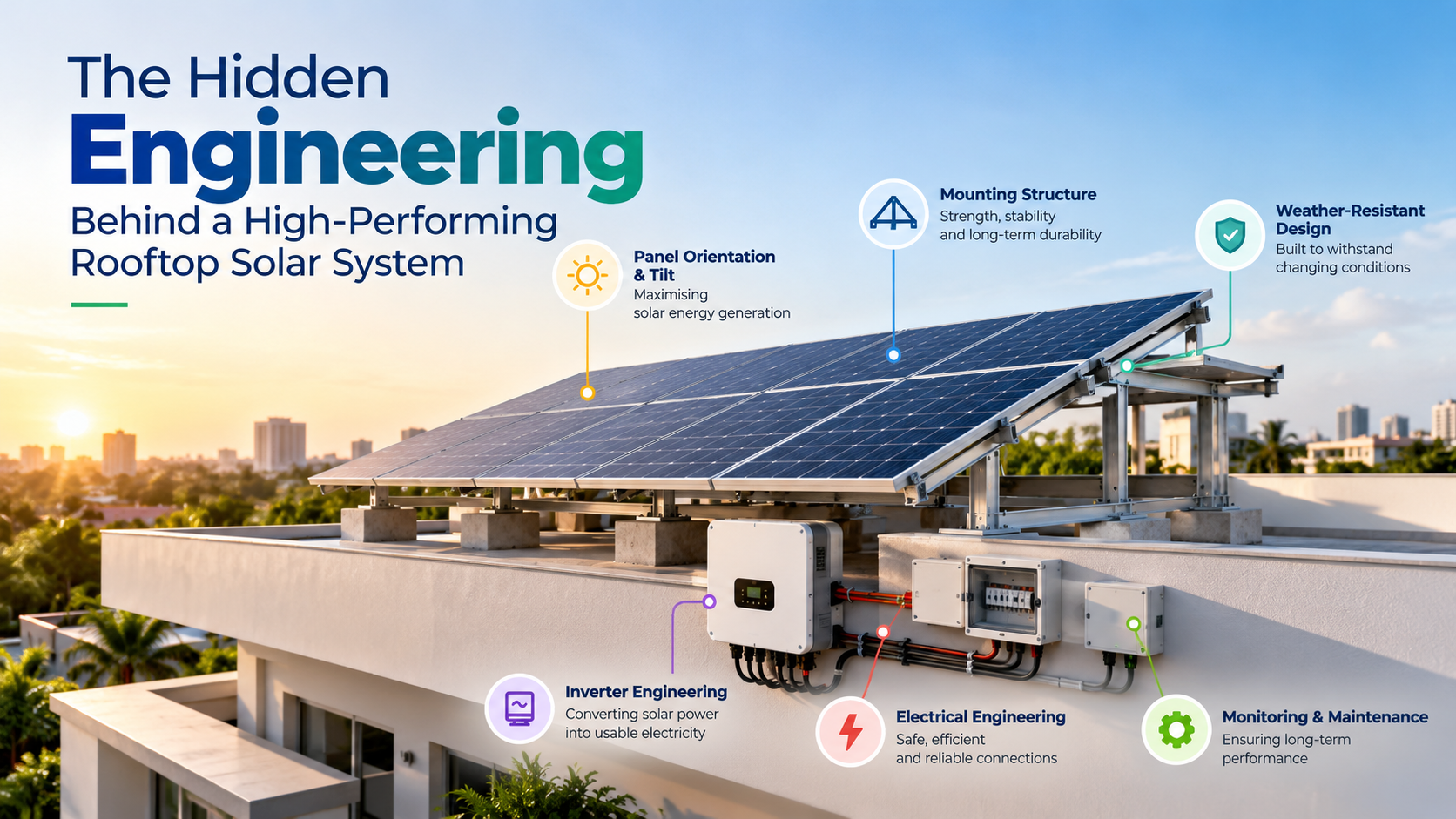
When people think about rooftop solar, the first thing that comes to mind is usually solar panels. While panels are essential for converting sunlight into electricity, they are only one part of a much larger system.
Behind every high-performing rooftop solar installation lies a combination of thoughtful planning, precise engineering, quality components and professional installation practices.
From the strength of the mounting structure to the efficiency of the inverter, every component contributes to how safely, reliably and effectively a solar system operates.
Understanding these engineering factors can help homeowners and businesses make informed decisions before investing in rooftop solar.
1. Structural Engineering: The Foundation of a Reliable Solar System
A rooftop solar system needs more than a suitable surface for mounting panels. The roof and mounting structure must safely support the installation while accounting for environmental conditions.
Solar mounting structures are designed to secure panels at the required orientation and inclination while resisting applicable wind loads.
Important structural considerations include:
Roof Load Assessment: Evaluating whether the existing roof can safely accommodate the additional weight of solar panels and supporting components.
Wind Load Resistance: Designing structures and connections to withstand site-specific wind conditions in accordance with applicable standards.
Corrosion Protection: Selecting suitable materials and protective coatings to reduce deterioration caused by moisture and environmental exposure.
Secure Mounting: Using appropriate anchors, clamps and fasteners to maintain structural stability.
In coastal regions such as Chennai, corrosion resistance and proper wind-load assessment are especially important.
A well-engineered mounting structure supports the long-term safety and reliability of the entire installation.
2. Panel Orientation and Tilt: Maximising Solar Energy Generation
Solar panels generate electricity when sunlight reaches their photovoltaic cells. However, the amount of energy produced depends partly on how effectively the panels receive sunlight throughout the day.
This makes panel orientation and tilt important engineering considerations.
Why Orientation Matters
In Chennai, south-facing panels are often a practical starting point for fixed installations seeking strong annual energy generation. However, the most suitable orientation depends on the roof layout, shading conditions and project requirements.
Why Tilt Matters
Panel inclination influences sunlight exposure, rainwater drainage and, in some cases, dirt accumulation.
The ideal tilt should be determined through site-specific assessment rather than applying the same angle to every rooftop.
The Importance of Shadow Analysis
Even partial shading from nearby buildings, trees, water tanks or rooftop structures can affect electricity generation.
Professional solar design considers shading patterns across different times of the day and seasons.
Careful placement and layout planning help maximise the productive use of available rooftop space.
3. Inverter Engineering: Converting Solar Power into Usable Electricity
Solar panels generate direct current (DC) electricity, while most household and commercial electrical systems operate using alternating current (AC).
The solar inverter performs the essential function of converting DC electricity into usable AC electricity.
However, modern inverters do much more than power conversion.
Key Inverter Functions
DC-to-AC Conversion: Converts electricity generated by solar panels into compatible AC power.
Maximum Power Point Tracking (MPPT): Continuously adjusts electrical operating conditions to help extract available power from the solar array.
System Monitoring: Provides information about generation, operating conditions and potential faults.
Grid Protection: Grid-connected inverters include protective functions designed to disconnect or stop energising the grid when required.
Selecting an inverter requires evaluating system capacity, voltage compatibility, MPPT requirements, environmental conditions and applicable grid standards.
An appropriately selected and configured inverter helps support efficient and reliable solar operation.
4. Electrical Engineering: Why Proper Wiring Matters
The electrical connections within a rooftop solar system are just as important as the panels themselves.
Poorly designed or incorrectly installed wiring can cause energy losses, overheating, electrical faults and safety hazards.
A professionally engineered installation considers:
Correct Cable Sizing
Cables must be selected according to electrical current, voltage drop, installation conditions and applicable safety requirements.
DC and AC Protection
Suitable protective devices, including appropriately rated isolators, circuit breakers and surge protective devices, are selected according to the system design and applicable standards.
Cable Routing and Management
Cables should be properly supported, protected against mechanical damage and routed to minimise unnecessary exposure to environmental stress.
Earthing and Bonding
Appropriate earthing and equipotential bonding arrangements help manage electrical safety risks and support the correct operation of protective systems.
Correct electrical design reduces avoidable losses and contributes to safer, more dependable operation.
5. Weather-Resistant Design: Engineering for Changing Conditions
Rooftop solar installations operate outdoors throughout the year.
They are exposed to sunlight, rainfall, temperature variations, wind and environmental pollutants.
In Tamil Nadu, seasonal rainfall, high temperatures and coastal conditions make weather-resistant engineering particularly relevant.
A reliable installation should consider:
Mounting structures designed for applicable wind loads.
Outdoor-rated electrical enclosures with suitable ingress protection.
Properly sealed cable entries and compatible connectors.
Corrosion-resistant mounting materials and fasteners.
Safe drainage paths that prevent unwanted water accumulation.
Appropriate cable protection against ultraviolet exposure and environmental damage.
Solar panels generate electricity from light, not heat. This means they can continue producing electricity during cloudy or rainy weather, although output generally decreases when available sunlight is reduced.
Weather-resistant engineering does not guarantee uninterrupted generation during severe weather. Its purpose is to help the system withstand the environmental conditions for which it has been designed.
6. System Design: Matching Solar Capacity to Actual Energy Needs
Installing more solar panels does not automatically result in the most suitable solar solution.
A well-designed rooftop solar system should reflect the customer's electricity consumption, available rooftop area and project objectives.
Before recommending a system capacity, engineers should assess:
Historical electricity consumption and billing patterns.
Available shadow-free rooftop space.
Roof condition and structural suitability.
Existing electrical infrastructure.
Daytime electricity demand.
Applicable grid connection and net-metering requirements.
Expected solar generation and financial feasibility.
For example, two buildings with similar roof areas may require different solar capacities because their electricity consumption patterns are different.
Proper system sizing helps balance installation cost, energy generation and long-term value.
7. Testing and Commissioning: Ensuring the System Is Ready to Perform
A rooftop solar installation should undergo appropriate inspection and testing before being placed into regular operation.
Commissioning verifies whether the installed system meets its design requirements and applicable safety standards.
Depending on the system, commissioning activities may include:
Checking mounting structure connections and installation quality.
Verifying DC cable polarity and electrical continuity.
Performing applicable insulation resistance tests.
Checking earthing and bonding arrangements.
Inspecting protective devices and electrical connections.
Confirming inverter configuration and operation.
Verifying monitoring and communication systems.
These procedures help identify installation issues before they affect safety or performance.
Professional commissioning is an important step towards dependable system operation.
8. Monitoring and Maintenance: Protecting Long-Term Performance
Even a properly designed solar installation requires periodic inspection and maintenance.
Dust accumulation, shading changes, loose connections, component deterioration and equipment faults can influence system performance over time.
A structured operation and maintenance approach may include:
Periodic solar panel cleaning using suitable methods.
Inspection of mounting structures and fasteners.
Checking electrical connections and protective components.
Monitoring inverter performance and fault alerts.
Reviewing energy generation against realistic expectations.
Inspecting cables and outdoor enclosures for deterioration.
Performance monitoring can help identify unusual reductions in generation, allowing issues to be investigated before they become more serious.
Preventive maintenance supports system reliability and helps protect the value of a long-term solar investment.
9. Why Engineering Quality Matters More Than Panel Capacity Alone
When comparing rooftop solar quotations, customers often focus primarily on panel wattage, system capacity and installation price.
However, two solar systems with the same installed capacity may perform differently because of differences in design, shading, component selection, installation quality and maintenance.
A lower upfront quotation may not always represent better long-term value if essential engineering and safety considerations have been overlooked.
A comprehensive solar proposal should therefore consider the complete system rather than only the number or wattage of panels.
Quality engineering contributes to:
Improved utilisation of available sunlight.
Reduced avoidable electrical losses.
Stronger structural reliability.
Better operational safety.
Easier maintenance and fault identification.
More predictable long-term performance.
The true value of a rooftop solar system lies in how effectively its individual components work together.
Frequently Asked Questions (FAQs)
1. Why is engineering important in rooftop solar installation?
Engineering ensures that the mounting structure, solar panels, inverter, wiring and protective devices are appropriately designed and integrated. It contributes to system safety, performance and reliability.
2. Does the mounting structure affect solar panel performance?
Yes. The mounting structure supports the panels at their designed orientation and tilt while providing structural stability. Poor positioning or inadequate structural design can affect generation or installation safety.
3. Can rooftop solar panels generate electricity during rainy weather?
Yes. Solar panels can generate electricity using available daylight, including diffuse light during cloudy conditions. However, electricity generation is generally lower when solar irradiance decreases.
4. How does an inverter improve solar system performance?
A suitable inverter converts DC electricity into AC electricity and uses functions such as maximum power point tracking to help optimise energy conversion under changing operating conditions.
5. How can homeowners identify a well-engineered solar installation?
Homeowners should look for a site assessment, structural evaluation, shading analysis, suitable component specifications, electrical protection, documented commissioning and a clear maintenance plan.
6. Does every rooftop require the same solar panel tilt?
No. Suitable tilt depends on geographic location, roof geometry, shading, wind considerations and project objectives. A site-specific design is preferable.
Conclusion: Great Solar Performance Begins with Great Engineering
A high-performing rooftop solar system is not defined by solar panels alone.
It is the result of multiple engineering decisions working together, from structural stability and panel positioning to electrical safety, inverter selection and long-term maintenance.
Every detail matters when designing a solar installation intended to deliver dependable performance over many years.
Investing in quality engineering helps homeowners and businesses make better use of available sunlight while supporting safe and reliable operation.
Build Your Solar Future with Daystar Solar
At Daystar Solar, we understand that successful rooftop solar installations require more than quality panels. They require careful planning, suitable components and attention to engineering details.
Whether you are planning a residential, commercial or industrial solar installation, our team can help you explore a rooftop solar solution designed around your energy requirements and site conditions.
Make every ray count with smarter solar engineering.
Explore rooftop solar solutions with Daystar Solar.
Website: https://www.daystarsolar.co.in/