Installing rooftop solar is an important step towards reducing electricity expenses and making better use of the sunlight your home receives. With growing interest in renewable energy across Chennai and Tamil Nadu, more homeowners are exploring solar power as a practical long-term investment.
However, choosing the right solar panels is only one part of the process. The success of a rooftop solar installation also depends on roof conditions, electricity consumption, system design, equipment quality and professional installation.
A poorly planned system may generate less electricity than expected, require avoidable modifications or increase maintenance expenses.
Before investing in rooftop solar, understanding a few common mistakes can help you make a more informed decision.
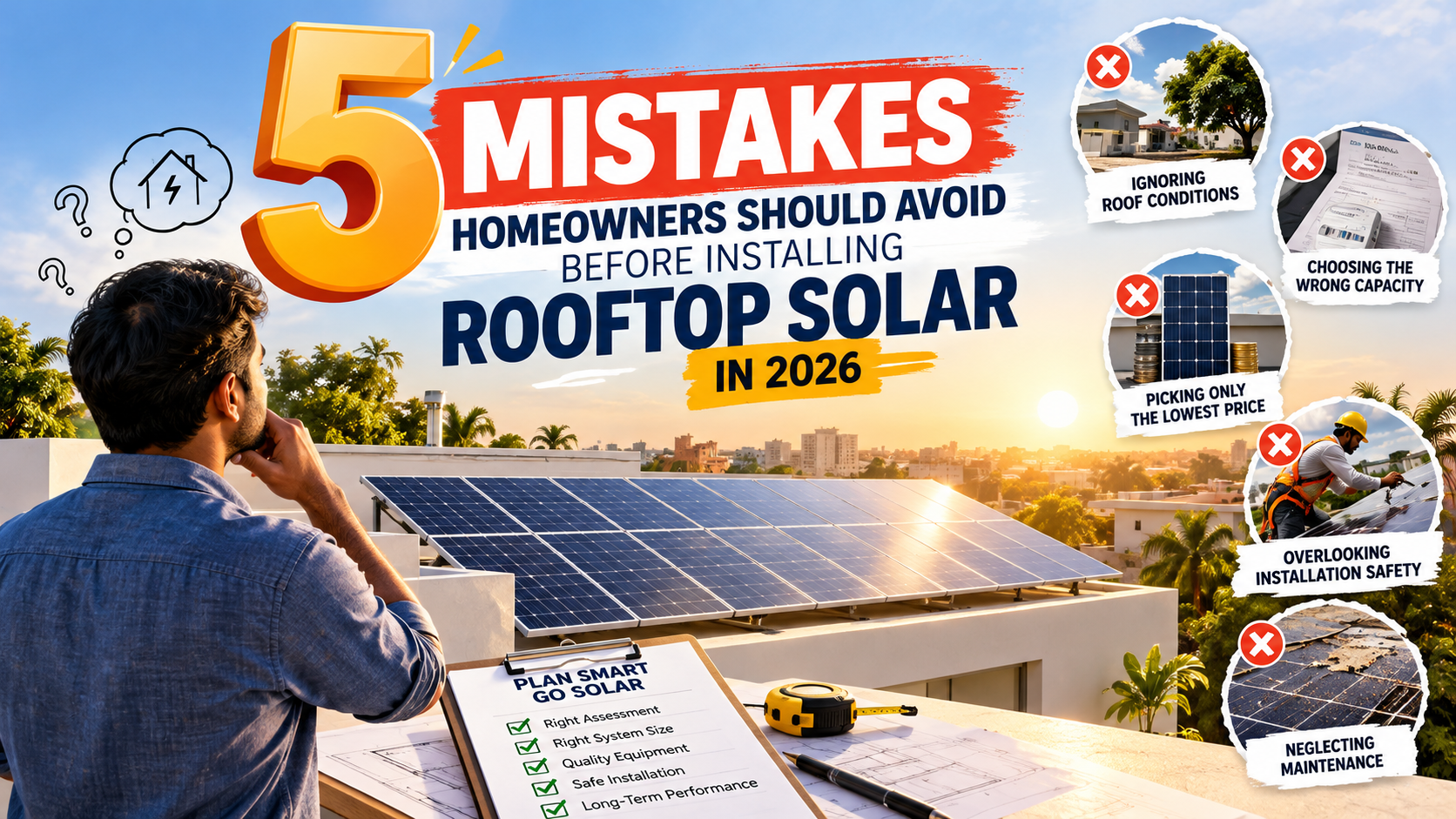
Here are five mistakes homeowners should avoid before installing rooftop solar in 2026.
1. Installing Solar Panels Without Checking Roof Conditions
One of the most common mistakes is assuming that every rooftop is automatically suitable for solar panel installation.
Although rooftop solar systems can be installed on many residential buildings, the roof must be assessed before installation.
Important factors include:
Roof strength: The structure must safely support the additional weight of solar panels and mounting equipment.
Roof condition: Existing cracks, leakage or waterproofing problems should be addressed before installation.
Shading: Nearby buildings, trees, water tanks and other obstacles may reduce solar energy generation.
Available space: Sufficient usable rooftop area is necessary for the proposed system capacity.
Panel orientation: The direction and tilt of panels influence how much sunlight they receive throughout the year.
For homes in Chennai, surrounding buildings, rooftop water tanks and future construction may influence the amount of usable sunlight.
How to avoid this mistake
Arrange a professional rooftop assessment before finalising the solar system. A suitable assessment should examine structural safety, shading, usable area and installation requirements.
This helps ensure the solar panels are positioned for practical, safe and efficient operation.
2. Choosing the Wrong Solar System Capacity
Another mistake is selecting a solar system based only on its price or the number of panels.
Every household has different electricity requirements. A home with multiple air conditioners, refrigerators and other high-consumption appliances may require a different system capacity from a home with relatively low electricity usage.
Installing an undersized system may not generate enough electricity to meet your expected savings target. An oversized system may increase your initial investment without providing proportionate financial benefits.
What should homeowners consider?
Before choosing a system, review:
Previous electricity bills and consumption in kilowatt-hours (kWh).
Average daily and seasonal electricity usage.
Daytime electricity consumption.
Future requirements, such as additional air conditioners or electric vehicle charging.
Available rooftop space and applicable electricity billing arrangements.
For example, a homeowner considering a 3 kW rooftop solar system should first understand how much electricity the household consumes and how much energy the proposed system is expected to generate.
The appropriate capacity cannot be determined from the electricity bill amount alone.
How to avoid this mistake
Request a system-sizing assessment based on your actual electricity consumption, rooftop conditions and future energy needs.
A properly sized solar installation can help improve the balance between investment, electricity generation and long-term savings.
3. Choosing Solar Panels Based Only on the Lowest Price
Budget is an important consideration when installing rooftop solar. However, selecting equipment based entirely on the lowest quotation can be a costly mistake.
Solar installations involve several components that work together to generate and deliver electricity safely.
These include solar panels, inverters, mounting structures, cables, electrical protection devices and monitoring equipment.
Differences in component quality, system design, installation workmanship and after-sales support can affect overall system performance.
What should homeowners compare?
When evaluating solar quotations, consider:
Solar panel technology: Compare the specifications and suitability of available technologies, including modern N-Type TOPCon panels.
Panel efficiency: Higher-efficiency modules can generate more rated power within a given panel area.
Inverter specifications: The inverter should be compatible with the system design and electrical requirements.
Safety components: Proper earthing, isolation and electrical protection are essential.
Product warranties: Review the coverage, duration, exclusions and claim process.
Installation quality: Professional workmanship is important for system reliability.
A lower upfront price does not necessarily mean better long-term value.
How to avoid this mistake
Compare complete solar system proposals rather than focusing only on panel prices.
Ask for a clear quotation that identifies the equipment specifications, installation scope, warranty terms and expected system performance.
4. Ignoring Installation Safety and Professional Expertise
Solar panel installation involves electrical equipment, rooftop mounting structures and connections to a building's electrical system.
Improper installation can create safety risks and affect system performance.
Some homeowners may focus mainly on the panel brand while overlooking the experience and technical capabilities of the installation team.
Why professional installation matters
A properly designed installation should consider:
Secure mounting structures suitable for local wind conditions.
Appropriate cable sizing and routing.
Correct earthing and electrical protection.
Suitable DC and AC isolation arrangements.
Safe inverter placement and ventilation.
Compliance with applicable electrical and utility requirements.
In coastal areas such as Chennai, environmental exposure and corrosion resistance are also important considerations when selecting suitable mounting materials and equipment.
For grid-connected systems in Tamil Nadu, homeowners should also understand the applicable approval, metering and commissioning requirements.
How to avoid this mistake
Choose a solar installation provider that follows recognised electrical safety practices and provides appropriate technical documentation.
Before commissioning, ensure that the system has undergone the necessary inspections and testing.
A professionally installed system supports safer operation and more dependable long-term performance.
5. Overlooking Maintenance, Warranty and After-Sales Support
Rooftop solar systems generally require relatively limited routine maintenance, but that does not mean they should be completely ignored after installation.
Dust, bird droppings, shading changes, damaged wiring or equipment faults may affect electricity generation.
In locations such as Chennai, airborne dust, seasonal rainfall and coastal environmental conditions can make periodic inspection particularly useful.
What maintenance should homeowners consider?
Routine solar system care may include:
Inspecting panels for visible dirt or damage.
Cleaning panels when necessary, following manufacturer guidance.
Monitoring electricity generation and identifying unusual performance changes.
Checking mounting structures and electrical components through qualified personnel.
Arranging professional inspections when faults or warning messages appear.
Homeowners should also understand the difference between a product warranty, a solar panel performance warranty and an installation workmanship warranty.
These warranties may cover different issues and may have different conditions.
How to avoid this mistake
Before selecting an installer, ask about maintenance support, warranty documentation, service response procedures and system monitoring options.
Having a clear after-sales support arrangement can help protect your investment and reduce avoidable interruptions.
Why Proper Solar Planning Matters for Tamil Nadu Homeowners
Tamil Nadu has significant potential for rooftop solar electricity generation, but every residential installation requires an individual assessment.
Sunlight availability, roof dimensions, electricity usage, system capacity and local grid requirements all influence the final design.
For homeowners planning rooftop solar installation in Chennai, careful planning can offer several advantages:
Better utilisation of available rooftop space.
More realistic electricity generation and savings estimates.
Improved installation safety.
Reduced risk of avoidable system modifications.
Greater confidence in long-term operation and maintenance.
Homeowners may also explore applicable government rooftop solar support programmes, including PM Surya Ghar: Muft Bijli Yojana.
Eligibility, technical requirements and financial assistance should always be verified through the relevant official government portals before making a purchase decision.
Frequently Asked Questions (FAQs)
1. What should I check before installing rooftop solar panels?
Check your roof's structural condition, available sunlight, shading, electricity consumption and usable installation area. A professional site assessment can help determine whether your home is suitable for rooftop solar.
2. How do I choose the right solar system capacity for my home?
The right capacity depends on your electricity consumption, available roof space, daytime usage and future energy requirements. Reviewing your previous electricity bills is a useful starting point.
3. Do rooftop solar panels require regular maintenance?
Yes. Although rooftop solar systems generally have relatively low maintenance requirements, periodic cleaning, performance monitoring and professional inspection help maintain reliable operation.
4. Can rooftop solar reduce my electricity bill?
Yes. Rooftop solar can reduce the electricity purchased from the grid. Actual savings depend on solar generation, household consumption, installation costs and applicable electricity billing rules. A zero electricity bill is not guaranteed.
5. Is professional installation necessary for rooftop solar?
Professional installation is strongly recommended because rooftop solar systems involve electrical safety, structural mounting, grid connectivity and technical compliance requirements.
6. Can I install rooftop solar on an older house?
Possibly. The suitability of an older house depends on the roof's structural strength, condition and available space. Repairs or structural improvements may be necessary before installation.
Conclusion: Plan Smart Before You Go Solar
Installing rooftop solar is more than choosing panels and placing them on your roof. It is a long-term investment that requires careful planning, appropriate technology and dependable installation practices.
Avoiding common mistakes such as ignoring roof conditions, choosing the wrong system capacity, prioritising low prices over equipment quality, overlooking installation safety and neglecting maintenance can help homeowners make better solar investment decisions.
With the right planning and professional guidance, rooftop solar can become a valuable part of your home's energy future.
Make the Right Solar Decision with Daystar Solar
Planning to install rooftop solar at your home in Chennai or anywhere in Tamil Nadu?
Daystar Solar can help you explore suitable rooftop solar solutions based on your property's conditions and electricity requirements.
Take the next step towards smarter energy use with a solar solution designed for your home.
Go Solar with Daystar Solar. Power Your Home, Save Smarter.
Contact Daystar Solar
Phone: +91 9176668617 / 32 / 34 / 50 / 51 / 57 / 64
Email: info@daystarsolar.co.in
Website: https://www.daystarsolar.co.in/