Solar energy is often installed with one main goal: reduce electricity bills
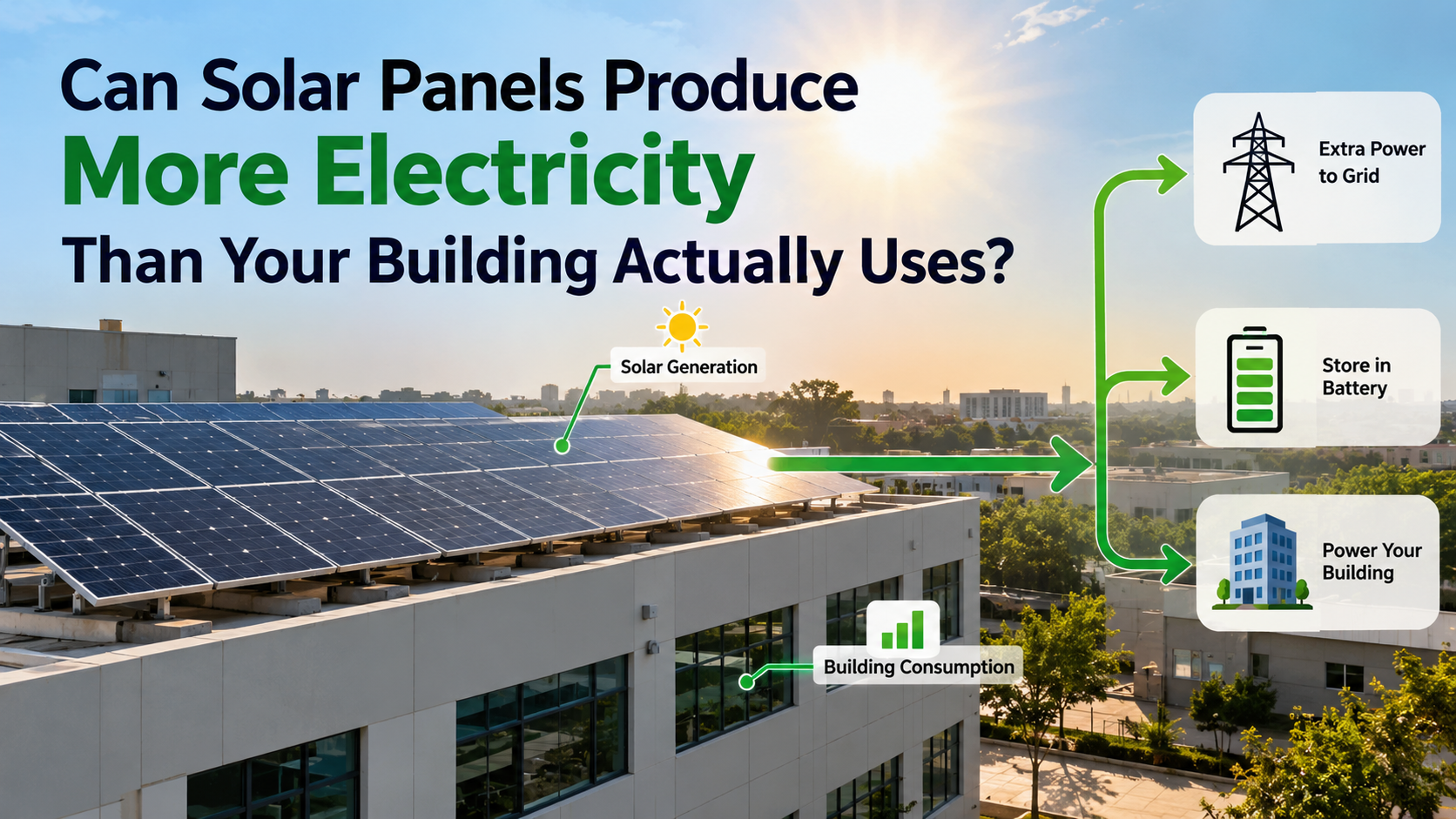
But what happens when your solar panels generate more electricity than your building actually needs?
Can that extra electricity be used somewhere else? Can it be sent back to the grid? Is producing more solar power always beneficial?
The answer depends on your solar system size, electricity consumption, local regulations, and metering arrangement.
Understanding the relationship between solar generation and electricity demand is important before deciding how large your solar system should be.
Solar Generation vs Building Consumption
Every building has its own electricity consumption pattern.
A factory, office, hospital, school, apartment or commercial building may consume different amounts of electricity throughout the day.
At the same time, solar panels produce electricity depending on available sunlight.
During bright daytime hours, your solar system may generate a large amount of electricity.
If your building is consuming less electricity than the solar system is producing at that moment, the system creates surplus solar electricity.
For example:
If your solar system is producing 100 kW while your building is consuming only 70 kW, then approximately 30 kW of solar generation is surplus at that moment.
What happens to this surplus depends on how the system is designed and connected.
Can Solar Panels Really Produce More Than You Need?
Yes.
A properly functioning solar system can sometimes generate more electricity than the building's immediate demand.
This commonly happens when:
Electricity consumption is low during the day
The solar system is relatively large
Weather conditions are favourable
Machinery or equipment is temporarily switched off
The building has reduced operations on weekends or holidays
The facility has seasonal variations in energy consumption
The solar panels continue generating electricity whenever sufficient sunlight is available, regardless of whether the building is using all of that electricity.
Where Does the Extra Solar Electricity Go?
There are several possibilities.
1. Exporting Electricity to the Grid
In a grid-connected solar system, surplus electricity may be exported to the electricity grid when permitted under the applicable metering arrangement.
A bidirectional meter can measure both:
Electricity imported from the grid
Electricity exported from the solar system
The treatment of exported electricity depends on local regulations, utility policies and the type of solar connection.
This is why businesses should understand the applicable net-metering, net-billing or other grid regulations before designing the system.
2. Storing Extra Electricity in Batteries
Another option is battery energy storage.
Instead of immediately exporting surplus solar electricity, some of it can be stored in batteries.
The stored electricity can then potentially be used later when solar generation is lower.
For example, electricity generated during the afternoon may be stored and used during:
Evening hours
Night-time operations
Periods of lower solar generation
Peak electricity demand periods
However, adding batteries increases the overall system cost, so battery capacity should be selected based on a proper energy analysis.
3. Limiting Solar Export
Some solar installations are designed with export limitations.
In certain situations, the system may reduce solar generation when the building cannot consume all the electricity and exporting to the grid is restricted.
This type of system may use controllers to ensure that electricity export remains within an allowed limit.
For businesses, this makes proper system sizing especially important.
Is Producing More Solar Electricity Always Better?
Not necessarily.
It may sound attractive to install the largest solar system possible, but solar should normally be designed according to the facility's actual requirements.
An oversized system may generate electricity that cannot always be used efficiently.
For example, imagine a commercial building that normally consumes 100 units of electricity during solar-generation hours.
If the solar system regularly produces 150 units while the building cannot effectively use or export the extra 50 units, some of the potential generation may provide limited financial benefit.
Therefore, the goal should not simply be:
“Install as many solar panels as possible.”
Instead, the better approach is:
“Install the right solar capacity based on electricity consumption and available space.”
Why Electricity Consumption Analysis Is Important
Before installing solar, businesses should analyse their electricity usage carefully.
Engineers may evaluate:
Monthly electricity bills
Daytime electricity consumption
Peak demand
Operating hours
Weekend consumption
Seasonal consumption
Planned expansion
Available rooftop or parking space
Applicable electricity tariff
Grid export regulations
This information helps determine the most appropriate solar system size.
For commercial and industrial customers, studying the electricity load profile can be particularly valuable.
Your Electricity Demand Changes Throughout the Day
A building does not consume the same amount of electricity every minute.
For example, a factory may have:
Morning: Machinery gradually starts operating.
Midday: Production reaches maximum capacity.
Afternoon: Electricity consumption remains high.
Evening: Production slows down.
Solar generation also changes throughout the day.
Typically, solar production increases after sunrise, becomes strongest around the middle of the day and decreases toward evening.
The most efficient solar installations often try to match solar production with the facility's daytime electricity consumption.
Example: Factory Solar Generation
Consider a factory with a rooftop solar system.
During normal production hours:
Factory demand: 400 kW Solar generation: 300 kW
The factory uses all the solar electricity and obtains the remaining electricity requirement from the grid.
Later, during lunchtime or reduced production:
Factory demand: 180 kW Solar generation: 300 kW
Now approximately 120 kW is temporarily surplus.
Depending on the system configuration and applicable regulations, that electricity may be exported, stored or limited.
This example shows why electricity demand and solar generation must be evaluated together.
What Happens During Weekends?
Weekend generation can be an important consideration for commercial and industrial solar installations.
Many factories and offices operate at lower capacity—or may remain completely closed—on Sundays or holidays.
However, the solar panels can still generate electricity.
If the building consumes very little electricity during these periods, a significant portion of solar generation may become surplus.
Therefore, businesses should consider weekly operating schedules while designing the solar system.
Should You Oversize Your Solar System?
Oversizing may make sense in certain situations, but it should be based on proper planning.
For example, a business may expect its electricity consumption to increase because of:
Factory expansion
New machinery
Additional air-conditioning
EV charging
New production lines
Building expansion
In such situations, engineers may consider future demand when designing the system.
However, unnecessarily oversizing a system without understanding how the extra electricity will be used can reduce the financial effectiveness of the project.
Bigger Solar Doesn't Automatically Mean Bigger Savings
When planning solar, businesses sometimes assume:
More panels = more savings.
But the reality is more complicated.
Savings depend on how much solar electricity can actually replace electricity that would otherwise have been purchased from the grid.
A well-designed system should balance:
Solar generation + Building consumption + Available space + Electricity tariff + Grid regulations
The objective is to achieve the most useful and economically effective solar generation—not simply the highest possible capacity.
The Importance of Proper Solar System Design
A professional solar assessment can help determine the appropriate capacity for your property.
The assessment may include:
Site inspection
Electricity bill analysis
Load-profile assessment
Roof-area measurement
Shading analysis
Solar generation estimation
Structural evaluation
Financial analysis
Future load planning
Using this information, engineers can design a solar system that matches the building's current and future electricity requirements.
Monitor Your Solar Generation
After installation, monitoring is equally important.
A solar monitoring system can show:
Current solar generation
Daily electricity production
Monthly generation
Building electricity consumption
Grid import
Grid export
System performance
Monitoring helps businesses understand whether they are consuming most of their solar electricity or regularly producing significant surplus power.
This data can also help identify opportunities to improve energy usage.
The Best Solar System Is the Right-Sized System
Solar panels can absolutely generate more electricity than your building is using at certain times.
But that doesn't mean every property should simply install the maximum number of panels possible.
A well-designed solar system should consider how much electricity your building consumes, when it consumes electricity and what happens to any surplus generation.
The objective should be to maximise the useful value of every unit of solar electricity produced.
For businesses, factories and commercial buildings, proper system sizing can improve energy savings and help achieve a stronger return on solar investment.
Planning a Solar System for Your Building?
Daystar Solar can evaluate your electricity consumption, available rooftop or parking space and energy requirements to help determine a suitable solar capacity.
From site inspection and system design to installation, monitoring and maintenance, our team can support your solar project from start to finish.
Contact Daystar Solar
Call: +91 91766 68617 / 32 / 34 / 50 / 51 / 57 / 64
Email: info@daystarsolar.co.in
Website: www.Daystarsolar.co.in
Generate the right amount of power. Use solar smarter with Daystar Solar.